| |
|
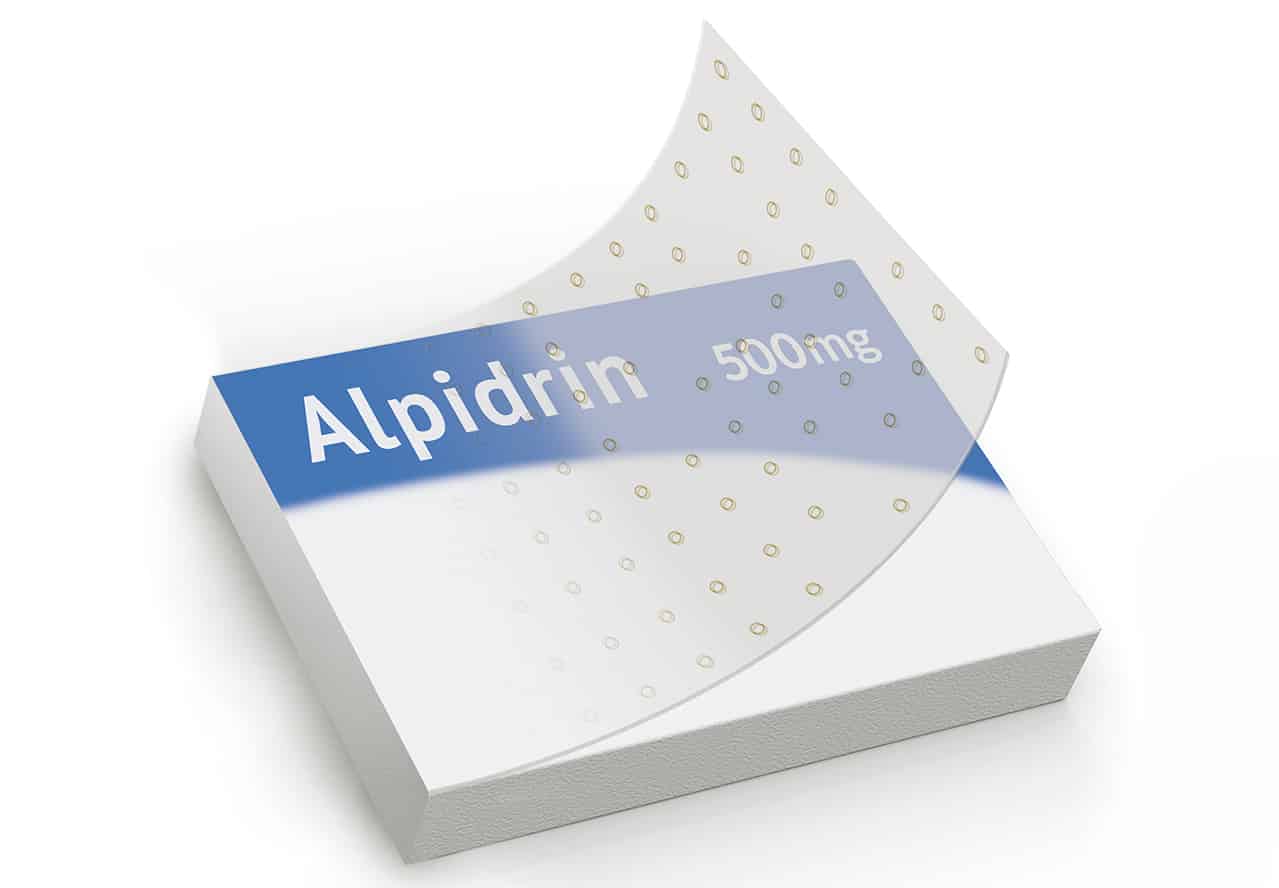
Cryptoglyph is the only security feature
in the world providing an invisible or covert marking
with standard ink and standard printing
processes.
|
| |
|
|
Cryptoglyph is the only security process
in the world providing an invisible marking
with standard ink and standard printing
processes (offset, rotogravure, flexo,
laser, inkjet, etc). Therefore, Cryptoglyph
can be easily integrated into any current
packaging production line or any document processing workflow before printing.
Simply embed the invisible Cryptoglyph
file in the prepress digital packaging
image file or have it generated before printing by your document processing system.
Cryptoglyph requires no packaging design
or any page template modification.
|
| Key features of Cryptoglyph are: | |
| |
 |
Invisible to the naked eye. |
 |
Not
localized on a part of the packaging or document,
therefore not identifiable as
present or not. |
 |
Can carry encrypted information
(128 bit encryption). |
 |
Uses standard
printing equipment. |
 |
Uses standard
visible ink. |
 |
Seamlessly
integrates into any packaging
manufacturing process or document processing system. |
 |
Detection
with standard electronic equipment
such as flatbed scanner or camera
phone. |
 |
Machine
readable for quality control
and high speed detection. |
|
|
 |
 |
| |
Typical
applications: |
 |
| |
 |
Brand protection against counterfeiting
and track & trace of unsolicited
importation (gray market) via primary
packaging, secondary packaging and
printed instructions. |
 |
Document
security for value documents, certificates,
identification documents, contracts, etc.. |
 |
Security
printing for offset, rotogravure,
flexo, laser, inkjet both for individual
and industrial printing. |
 |
Adaptable to customer specific needs
and integrated into existing workflows. |
|
 |
Watch
the video to see how the Cryptoglyph invisible marking
is produced using visible ink and standard
packaging manufacturing processes.
|
 |
|
Security basics: | |
Security
features can be roughly sorted in two categories:
Visible or OVERT security features.
Invisible or
COVERT security features. |
The
advantage of a covert solution, such as Cryptoglyph, is that counterfeiters
do not know that there is a security element present and therefore cannot
attack it. If the feature is visible,
the point of attack is evident. |
|
(click on the image to enlarge) |
| |
Standard ink: |
(click on the image to enlarge) |
Unlike processes that use additional elements such as special inks, holograms, taggant or special labels, Cryptoglyph (Crypto = encryption, glyph = marks) is printed with standard inks during the standard printing process. The Cryptoglyph security solution is a covert security solution. This means it is invisible to the naked eye and is only perceptible when using appropriate equipment.
As Cryptoglyph does not need any specific hardware or additional security feature elements, it is the most cost effective security solution (see figure on the left). |
|
| The Cryptoglyph
combines two elements: | |
1. Printing of invisible micro-points over
the entire surface of the primary packaging
or secondary packaging, such as the blister
foil or the entire document. As these dots
are invisible and spread on the entire surface
of the packaging or the document, it is
impossible to replicate or to erase them.
The figure (above right) shows the area of invisible
dots depending on the size and the color
of the dots as well as the printed background.
2. These invisible micro-points contain encrypted information, which can only be deciphered by using a 128 bit encryption key. |
If the detection process is performed in a unique and secured place, the key is never endangered. Deciphering the information by a fraudulent party is impossible.
These micro-points are integrated into the package design before printing and are invisible to the naked eye. They are very difficult to distinguish - even under magnification - as the dots are hidden in the imperfections found in all printed material and thus completely camouflaged. The same technology is applied for both document and brand protection, as both use identical industrial printing processes. |
 |
|
Camouflage within the printed material: |
 |
This
camouflage feature, using the imperfections
of the printed material, is one of the unique
aspects of AlpVision Cryptoglyph technology.
The detection software is based on advanced
signal detection capabilities that have
very low signal-to-noise ratios and built-in
conceptual redundancies.
The AlpVision technology
surpasses other technologies, such as the
two dimensional matrix code because, by definition,
the code requires contrasts in visible
black-and-white. |
 |
| Detection via consumer
electronics: | |
The Cryptoglyph detection
process uses a standard flatbed scanner
or a mobile phone equipped with a digital
camera (camera phone).
The authentication process
may be performed locally or remotely in a safe and
secured area to avoid any dissemination
of the encryption key. In the case of remote authentication, results can be immediately returned to the field controller anywhere in the world via the mobile phone or PC screen. |
 |
 |
|
|
Contact
AlpVision if you need to know more or how
the Cryptoglyph technology can be applied
to your brand or document protection.
Cryptoglyph
is a registered trademark and a patented process
of AlpVision SA. It is part of the AlpVision digital imaging security solutions.
|
See industrial partners who integrated
successfully the Cryptoglyph in their security
printing. |
| |